Good Stories for Kids: Build Listening Skills (and Comprehension)

Updated: Sep 16
Good Stories for Kids: How Reading Aloud Builds Listening Skills (and Comprehension)

Below are practical, teacher-tested ideas you can use at home, plus examples of children’s stories that naturally encourage attention, vocabulary growth, and early literacy skills.
Why Do Good Stories for Kids Help Listening and Comprehension?
When children listen to a story, they practice:
Focusing attention for longer stretches.
Following sequence (beginning, middle, end).
Understanding cause and effect.
Learning new vocabulary in context.
Predicting what happens next.
These are the same building blocks that support reading comprehension for kids later on.
Teacher Strategies That Build Listening Skills for Kids
Let’s see how a savvy teacher can develop some of these listening skills in children:
Teachers can model active listening skills with their students to show what it looks like to be an active listener by making eye contact, participating in meaningful conversations with students, and asking follow-up questions. . . . a fun classroom activity could be to model what active listening is not. Teachers could act like poor listeners by looking around the room, glancing at their phones, or simply walking out of the classroom. The key to this activity is to make everything dramatized so that it is evident that the teacher is using poor listening skills. Once teachers have demonstrated what it looks like to be a lousy listener . . . , students could have a classroom discussion about what the teacher did wrong and how it likely impacted the speaker. (Developing Listening Skills for Kids/Listenwise) |
As a parent, you can adopt some of these methods to alert your child if she’s not focusing. Pair those moments with consistent story time—because the benefits of reading aloud include stronger attention, richer vocabulary, and better listening and comprehension.
A Real-Life Reminder: Babies Learn by Listening First
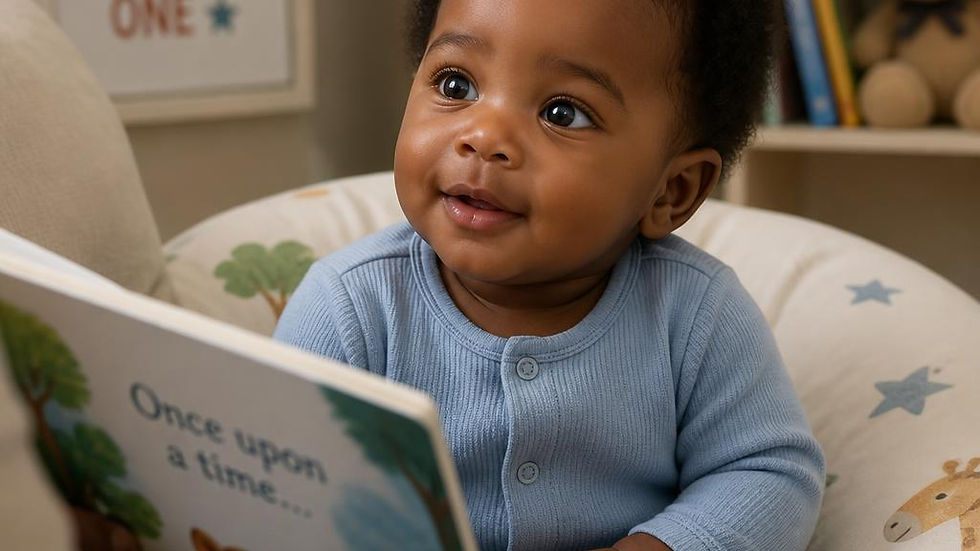
There’s an eight-month-old baby in my family. We call him Coco. He’s alert and curious. He stares at the person holding him. He also watches the cat and dog as they pass by. The baby turns his head to locate the source of the music. When an item is placed in his hand, he explores the texture. Variety is key. Different textures, sounds, and smells keep him interested.
Although Coco’s too young to understand the stories read to him, his vocabulary can begin with simple words like "ma-ma" and "da-da." However, his older sisters and brother are great candidates to learn from reading good stories for kids.
When communicating stories for children, they must listen and understand. Using their names often will grab their attention and keep it. If children feel that you care about them, they will put more effort into communicating, which involves listening and understanding.
According to Gov. UK, “Listening . . . means interpreting different sounds, while beginning to understand social interactions. Understanding means processing what’s being communicated, beginning with simple ideas and vocabulary.”
Just as baby Coco gathers information through all of his senses, good stories for kids engage all of theirs. Children love whimsy, fantasy, and imaginative settings. They enjoy imagining ordinary things in extraordinary ways. They like to hear animals talk.
While listening to unique stories, children often exclaim, “WOW!” Good stories lift them up and away over housetops and mountaintops. The world in which kids live can feel mundane at times. They need a fantastical journey. Given this, children will be more likely to learn, listen, and build their vocabularies.
Children love songs and learn from them. The ABCs can be learned through song. They also adore rhymes.
For instance, when I recite the following rhyme to children, they laugh, their eyes light up, and they spend quite a bit of time trying to repeat it. They become fully engaged. Learning it also improves their pronunciation and vocal agility.
You’ve probably heard of "Peter Piper." Here it is:
Peter Piper picked a peck of pickled peppers. If Peter Piper picked a peck of pickled peppers, how many pickled peppers did Peter Piper pick if he picked a peck of pickled peppers? |
“Peter Piper” is a popular tongue twister and nursery rhyme originally from England. It was first published in John Harris’ "Peter Piper’s Practical Principles of Plain and Perfect Pronunciation" in 1813.
Story Examples That Naturally Strengthen Listening Skills
I wrote a short story for my friend’s granddaughter. It’s about a secret garden with a talking gray cat and a talking marigold flower. This flower tends to blush when complimented.
The little girl in the story is the cat’s friend. She is called upon by a talking grasshopper who needs her help to save his girlfriend, who is caught in a spiderweb. The little girl and the cat team up to save the grasshopper’s girlfriend from a giant robotic spider.
The Secret Garden (excerpt)
The cat and the girl narrate the story at different intervals. Here’s an excerpt from the story as narrated by the cat:

“I chase mice and birds. I enjoy stretching, too. Yes, I do downward-facing dog poses because they come naturally to me. But ugh, I shouldn't mention the word "dog." The thought makes me cringe. This is one reason my comfort zone is high in the tree. A dog cannot attack me there. Also, I can peer down over the entire garden. I learn many secrets from this vantage point that others can never know.”
A child's attention is also captured through reading about movement. Here, we read about movement, evidenced by the cat stretching.
The Magic of Reading Aloud
Reading aloud is not just a delightful pastime; it’s a magical experience. It creates a bond between the reader and the listener. As we turn the pages, we embark on adventures together. Each story becomes a bridge connecting our hearts and minds.
When we read aloud, we invite children into worlds filled with wonder. They can explore enchanted forests, meet talking animals, and even travel to distant galaxies. These journeys spark their imaginations and encourage them to dream big.
As we read, we also introduce new words and ideas. Each story is a treasure chest of vocabulary waiting to be discovered. Children learn to express themselves better, and their confidence grows. They begin to weave their own tales, inspired by the stories they hear.
Conclusion
A simple takeaway: Good stories for kids to read and listen to will enhance the listening and comprehension skills they will need for life. These help build their vocabulary and rescue them from the mundane by offering them a measure of adventure and entertainment.
Sources






Comments